Highlights
- Multi-camera productions rely on coordinated equipment that keeps video, audio, and communications synchronized from capture through delivery.
- A reliable production workflow includes cameras, switchers, routing, monitoring, intercom systems, and recording solutions that work together.
- Professional equipment helps reduce latency, improve signal reliability, and simplify live decision-making during broadcasts and events.
- Flexible system design allows production teams to scale from small corporate events to large sports, concerts, and broadcast productions.
- Monitoring and redundancy are just as important as camera quality for maintaining consistent live production.
- Choosing compatible equipment based on production needs helps improve efficiency while reducing technical risks during live events.
Why Does Live Production Equipment Matter for Multi-Camera Events?
Live production equipment forms the backbone of every successful multi-camera event by connecting multiple video, audio, and communications systems into a coordinated workflow. Whether covering a sporting event, concert, conference, worship service, or corporate presentation, production crews must capture numerous camera angles while ensuring every signal reaches the production switcher with minimal delay.
Unlike recorded productions, live events leave little opportunity to correct mistakes after the fact, making dependable equipment essential for maintaining broadcast quality. Professional production systems allow directors to change camera angles instantly, operators to monitor every source simultaneously, and engineers to maintain stable signal paths throughout the event. As productions increasingly incorporate streaming platforms, remote contributors, and HDR workflows, selecting equipment designed for reliability and interoperability has become even more important. The European Broadcasting Union notes that modern live production environments continue evolving toward IP-based infrastructures that increase flexibility while maintaining professional broadcast standards.
What Equipment Forms the Foundation of a Multi-Camera Production?
Every multi-camera workflow begins with several essential components working together rather than functioning independently. Cameras capture the action, but additional equipment ensures each signal can be monitored, switched, recorded, and delivered without interruption. A typical professional setup includes:
- Professional cameras that provide consistent image quality and matching color profiles.
- Video switchers that allow directors to transition between camera angles in real time.
- Camera control systems for matching exposure, white balance, and color across all cameras.
- Signal converters and routers that distribute video throughout the production environment.
- Audio mixers that synchronize microphones, music, commentary, and ambient sound.
- Recording devices that capture isolated camera feeds and the final program output.
- Professional monitors used for waveform analysis, preview, and program monitoring.
Each component contributes to a stable workflow, and compatibility between devices often matters more than purchasing the highest individual specifications.
How Do Video Switchers Keep Live Productions Running Smoothly?
Video switchers serve as the operational center of a live production by allowing directors to choose which camera, graphic, replay, or remote source appears on the program feed. Modern switchers perform far more than simple camera cuts. Many support transitions, keying, picture-in-picture layouts, replay integration, graphics insertion, and multiple simultaneous outputs for streaming, recording, and venue displays. Because directors make rapid decisions throughout an event, switchers must respond immediately while maintaining synchronized audio and video signals. Production crews also benefit from customizable control panels, programmable macros, and multiview monitoring that displays every available source on a single screen. According to the Society of Motion Picture and Television Engineers (SMPTE), maintaining synchronization and consistent timing throughout professional production systems is fundamental to delivering reliable broadcast-quality content. Selecting a switcher with sufficient inputs and expansion capabilities also allows organizations to accommodate future production growth without replacing their entire workflow.
Why Are Monitoring and Communications Critical During Live Productions?
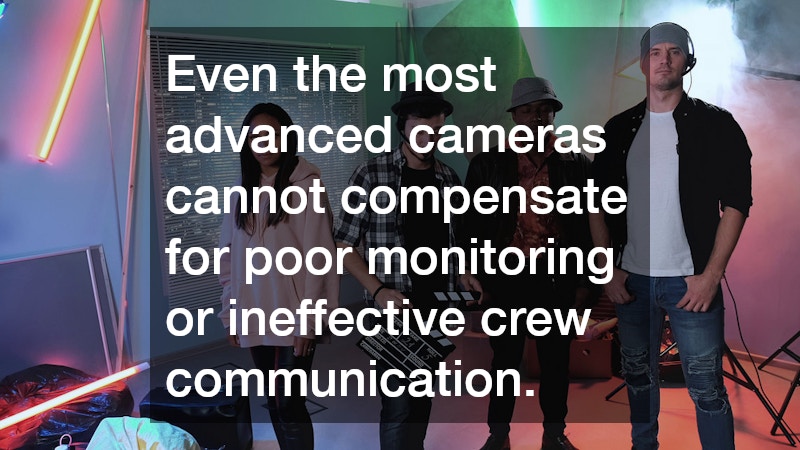
Even the most advanced cameras cannot compensate for poor monitoring or ineffective crew communication. Directors, technical directors, engineers, and camera operators all depend on real-time information to make accurate production decisions under tight deadlines. Effective monitoring and communications typically include:
- Multiview displays that present every camera feed, preview window, and program output simultaneously.
- Waveform monitors and vectorscopes for verifying exposure, luminance, and color accuracy.
- Intercom systems connecting directors, camera operators, replay operators, and audio engineers.
- Confidence monitors that allow presenters and performers to view live program feeds.
- Program return feeds enabling remote talent to stay synchronized with the production.
These systems improve collaboration while helping crews identify technical issues before viewers notice them. Reliable communication becomes increasingly valuable as productions expand across larger venues or incorporate remote contributors.
How Does Reliable Signal Distribution Improve Production Quality?
Signal distribution ensures that every video and audio source reaches its intended destination without degradation or excessive delay. A live production may simultaneously route signals to production switchers, recording devices, streaming encoders, LED displays, replay servers, broadcast transmission systems, and monitoring stations. Professional routing equipment simplifies this process while reducing unnecessary cable runs and improving operational flexibility. Today’s productions often combine SDI and IP technologies, allowing facilities to scale workflows while supporting higher resolutions and remote production models. Reliable distribution also minimizes synchronization issues that could affect switching accuracy or audio alignment. Organizations planning long-term infrastructure upgrades should consider equipment that supports evolving broadcast standards while maintaining compatibility with existing hardware. The European Broadcasting Union has published extensive guidance encouraging broadcasters to design flexible infrastructures capable of supporting future production requirements alongside current operational needs.
What Should Teams Consider When Selecting Live Production Equipment?
Choosing live production equipment requires balancing performance, scalability, and operational requirements rather than focusing on individual specifications alone. Production teams should evaluate equipment based on several practical considerations:
- Production size and the number of simultaneous camera sources.
- Required video formats, including HD, UHD, HDR, or high-frame-rate production.
- Compatibility with existing SDI or IP infrastructure.
- Available recording, streaming, and replay capabilities.
- Expansion options for future productions.
- Reliability, manufacturer support, and long-term maintenance.
- Ease of operator training and day-to-day workflow management.
- Power requirements and portability for mobile production environments.
Selecting interoperable equipment can reduce integration challenges while providing flexibility as production requirements evolve. Investing in scalable infrastructure often proves more cost-effective than replacing isolated components later.
How Do Redundancy and Backup Systems Protect Live Broadcasts?
Professional live productions rarely rely on a single piece of equipment because hardware failures, damaged cables, or unexpected power interruptions can disrupt an event instantly. Redundancy minimizes these risks by providing alternate signal paths and backup devices that take over when primary systems encounter problems. Backup power supplies, redundant recording systems, duplicate network connections, secondary program outputs, and spare communication systems all contribute to production resilience. Large broadcast operations frequently duplicate mission-critical components, while smaller productions may prioritize backup recording and power solutions based on available budgets. Engineers also conduct pre-event testing to verify signal integrity and confirm that failover systems operate correctly before audiences arrive. Planning for unexpected situations is often just as important as selecting high-performance equipment, since even minor technical issues can become highly visible during live broadcasts.
How Can the Right Equipment Improve Multi-Camera Production Success?
The right live production equipment allows production teams to focus on storytelling rather than troubleshooting technical limitations. Reliable cameras, switchers, monitoring systems, communications, routing infrastructure, and recording solutions work together to create an efficient workflow capable of supporting everything from corporate meetings to international sporting events. As production technologies continue evolving toward IP connectivity, higher resolutions, HDR, and hybrid remote workflows, investing in flexible and interoperable equipment becomes increasingly valuable. Organizations should evaluate complete production systems rather than isolated products, ensuring every component contributes to dependable operation under real-world conditions. When equipment is carefully selected, properly integrated, and supported by thoughtful redundancy planning, production teams gain the confidence to deliver consistent, professional-quality live content regardless of the size or complexity of the event.
Sources
- Society of Motion Picture and Television Engineers (SMPTE) – Standards Overview:
https://www.smpte.org/standards/overview - European Broadcasting Union (EBU) – Technology & Innovation:
https://tech.ebu.ch - Advanced Television Systems Committee (ATSC) – ATSC Standards:
https://www.atsc.